How to Choose a Plant Protein Powder: What to Look For
Share

Plant protein powders have become increasingly popular, but choosing between them is not always straightforward.
Two products can both be labelled “plant protein” yet differ considerably in their protein sources, amino-acid profile, ingredient list, processing and overall formulation.
So what should you actually look for?
Rather than judging a protein powder by one headline number, it is worth looking at the formulation as a whole.
At a glance: When comparing plant protein powders, consider the amount of protein per serving, where that protein comes from, the amino-acid profile, digestibility, ingredient quality and what else has been added to the formulation.
1. Start with the amount of protein per serving
The first thing most people look at is the amount of protein.
That matters, but context is important.
Look at the grams of protein per serving, rather than simply the percentage shown on the front of the pack. Serving sizes can vary considerably between products, which can make comparisons misleading.
A protein powder should also fit within the rest of your diet rather than replace the importance of protein-rich wholefoods.
How much protein someone needs will vary depending on factors such as age, body size, activity levels and overall diet.
If you are particularly interested in protein requirements during midlife, read our guide to protein intake during perimenopause.
2. Look at which plant proteins are being used
Not all plant proteins have the same amino-acid profile.
Proteins are made from amino acids, nine of which are considered essential because the body cannot produce them and they therefore need to come from the diet.
This is one reason plant protein powders often combine more than one protein source.
For example, pea protein is relatively low in the essential amino acid methionine, while rice protein is relatively low in lysine. Combining the two can therefore create a more balanced amino-acid profile.
A useful question: Rather than asking only “How much protein does this contain?”, also ask “Where is that protein coming from?”
3. Check the amino-acid profile
Amino-acid quality is an important part of evaluating any protein source.
Some plant proteins naturally contain lower proportions of certain essential amino acids, which is why combining different sources can be useful.
A pea-and-rice protein blend is one example of this complementary approach.
That does not mean every protein powder needs a long list of protein sources. What matters is whether the formulation provides a useful overall amino-acid profile rather than relying on a single headline ingredient.
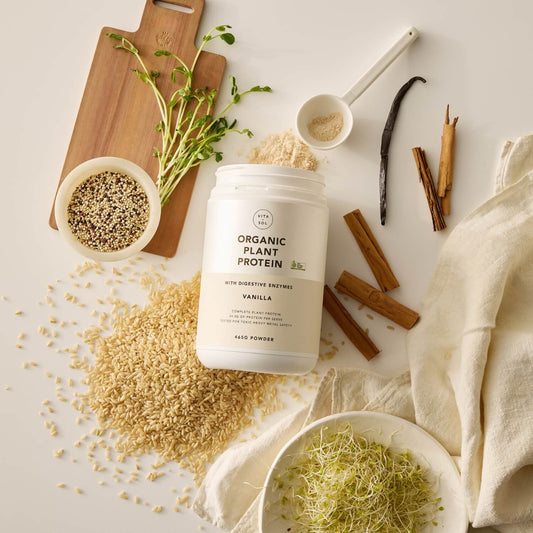
Vita-Sol Organic Plant Protein combines sprouted fermented pea protein with sprouted brown rice protein, specifically bringing two complementary plant protein sources together for a complete amino-acid profile.
4. Consider digestibility as well as protein quantity
Protein content tells you how much protein is present.
It does not tell you everything about the formulation.
Processing methods, the protein source and the other ingredients included in the product can all influence how a protein powder fits into your diet.
Some formulations use techniques such as sprouting or fermentation, while others include digestive enzymes.
Vita-Sol Organic Plant Protein contains a digestive enzyme blend of amylase, protease, lipase, cellulase and lactase alongside its plant protein sources.
The wider lesson is simple: when comparing products, look beyond the protein number and consider how the product has actually been formulated.
5. Read the whole ingredient list
This is one of the most useful habits when choosing a protein powder.
Many products contain ingredients beyond the protein itself, including flavours, sweeteners, gums, emulsifiers, bulking agents or other additives.
That does not automatically make a product poor quality, but it is worth understanding what is present and why.
If you are specifically looking for a protein powder without additives, check the ingredient list rather than relying only on front-of-pack marketing.
Vita-Sol Organic Plant Protein is formulated without fillers, bulking agents, emulsifiers, added sugar or artificial flavours, and contains no dairy, soy or gluten.
Nothing Unnecessary. Just as Nature Intended.
For Vita-Sol, thoughtful formulation is not simply about adding more ingredients. It is about carefully considering what belongs in the formulation — and what does not.
6. Look beyond sweetness and flavour
Taste matters, particularly if you plan to use a protein powder regularly.
But sweetness can come from very different sources.
Some powders use added sugars, while others use artificial sweeteners or naturally derived alternatives.
It is worth checking what has been used rather than simply assuming that a sweet-tasting powder contains sugar.
Vita-Sol Organic Plant Protein uses natural vanilla flavour, organic Ceylon cinnamon and monk fruit extract as part of its formulation.
The aim should be to find something that fits comfortably into your routine without making flavour the only consideration.
7. Consider whether the formulation offers more than protein alone
Protein powder does not necessarily need to be complicated.
But there can be value in looking at whether the supporting ingredients have a clear purpose.
For example, a formulation might also include fibre or carefully selected wholefood ingredients.
Vita-Sol Organic Plant Protein contains organic acacia fibre together with an organic sprout blend including amaranth, quinoa, millet, buckwheat, chickpea, lentil, flax, chia and other sprouted ingredients.
This reflects Vita-Sol’s wider approach to wholefood nutrition: nutrition is rarely about one isolated ingredient.
It is about how carefully selected ingredients work together within the formulation as a whole.
8. Check certifications and dietary suitability
If organic certification or particular dietary requirements matter to you, look for proper third-party certification rather than relying simply on words such as “natural” or “clean”.
When comparing products, you may want to check:
- whether the product is suitable for a vegan diet
- whether it contains dairy, soy or gluten
- whether organic claims are independently certified
- allergen information
- serving size
- how easily the product fits into your normal diet
Vita-Sol Organic Plant Protein is third-party certified organic by ACO and uses certified organic plant protein sources.
9. Don’t assume more automatically means better
It is easy to compare protein powders by looking for the largest number on the label or the longest ingredient list.
But formulation quality is rarely that simple.
A useful comparison should consider:
- Protein amount
- Protein source
- Amino-acid balance
- Ingredient quality
- Processing
- Digestibility
- Added ingredients
- Dietary suitability
The same principle applies across nutrition more broadly.
More is not always better. Thoughtful formulation matters.
What does Vita-Sol look for in a plant protein?
Vita-Sol Organic Plant Protein was developed around the idea that a protein powder should provide useful dietary protein without unnecessary complexity.
Each 31g serving provides 24.5g of protein.
The formulation combines:
- organic sprouted fermented pea protein
- organic sprouted brown rice protein
- organic acacia fibre
- an organic sprout blend
- a five-enzyme digestive enzyme blend
- organic Ceylon cinnamon
- natural vanilla flavour
Rather than focusing only on the headline protein number, the formulation brings together complementary plant proteins and carefully selected supporting ingredients.
Looking for a thoughtfully formulated plant protein?
Discover Vita-Sol Organic Plant Protein Vanilla, with 24.5g protein per serve, complementary pea and rice proteins and digestive enzymes.
Frequently asked questions about plant protein powder
Is pea protein a complete protein?
Pea protein contains all nine essential amino acids, although the relative proportions differ from those of some other protein sources. In particular, pea protein is relatively lower in methionine, which is one reason it is often combined with another plant protein such as rice protein.
Why combine pea and rice protein?
Pea and rice proteins have complementary amino-acid profiles. Pea is relatively lower in methionine, while rice is relatively lower in lysine, so combining them can help create a more balanced overall amino-acid profile.
What should I look for in a protein powder?
Look beyond protein quantity alone. Consider the protein sources, amino-acid profile, ingredient list, processing, dietary suitability and whether any additional ingredients have a clear role within the formulation.
What should I avoid in a protein powder?
There is no single ingredient that everyone needs to avoid. Instead, read the full ingredient list and decide whether each ingredient has a useful role in the formulation.
If your preference is for a simpler formulation, you may want to look for a protein powder without additives such as fillers, bulking agents, emulsifiers or added sugar.
Are digestive enzymes necessary in protein powder?
Not necessarily. They are an additional formulation feature rather than something every protein powder must contain.
Some products, including Vita-Sol Organic Plant Protein, include digestive enzymes alongside their protein sources.
Is organic protein powder better?
Organic certification does not automatically tell you everything about the quality of a protein powder.
It can, however, provide additional information about how ingredients have been produced and certified. It is best considered alongside the protein sources, amino-acid profile, ingredient list and overall formulation.
Protein as part of the bigger nutritional picture
Protein is one part of a balanced diet and works alongside essential fats, carbohydrates, vitamins, minerals and a diverse range of wholefoods.
If you are interested in the wider relationship between diet and skin wellbeing, read our guide to nutrition for healthy skin.