The Gut–Liver–Skin Axis Explained
Share

Looking Beyond the Skin Alone
For many years, skin health has largely been approached from the outside in.
We cleanse, moisturise, protect from UV exposure and, when appropriate, seek professional treatments to improve the appearance and function of the skin. These remain fundamental aspects of good skin care and continue to play an important role in aesthetic practice.
What has changed over the past decade is our understanding of how interconnected the body's systems are.
Research is paying increasing attention to the relationship between the gut, liver and skin, and to the ways changes within one system may influence another. This growing area of study has given rise to what is commonly referred to as the Gut-Liver-Skin Axis.
Rather than replacing conventional treatments, the Gut-Liver-Skin Axis broadens the conversation. Instead of looking at the skin in isolation, it considers how nutrition, digestion, metabolism and the microbiome may all form part of the wider picture of skin health.
Dr Stephanie Damalis often summarises the concept in three simple sentences:
- The gut decides what gets absorbed.
- The liver decides how it's processed.
- The skin shows the result.
The biology is more complex, of course, but the framework is a useful way to understand how these systems connect.
In This Article
- What is the Gut-Liver-Skin Axis?
- How the gut, liver and skin communicate
- Why the gut microbiome matters
- Why microbial diversity has become important
- Prebiotics, postbiotics and butyrate
- Why plant diversity matters
- What "30 plants a week" actually means
- The role of the liver in the Gut-Liver-Skin Axis
- What research suggests about the Gut-Skin Axis and skin health
- Food first: supporting the microbiome through diet
- Where Purity Greens fits
- Frequently asked questions
Understanding the Gut-Liver-Skin Axis
Although the Gut-Liver-Skin Axis sounds complex, the principle is fairly straightforward.
The gut, liver and skin do not operate in isolation. They form part of an interconnected system, communicating through immune, hormonal and metabolic signalling pathways. Each organ has its own role, but the activity of one can influence the others.
Communication
Signals generated in the gut can influence the liver. The liver processes and responds to many gut-derived substances before they enter the wider circulation. Changes in immune activity, metabolism and inflammatory signalling may then have effects elsewhere in the body, including the skin.
This is why it can be more useful to think of the gut, liver and skin as parts of an integrated network rather than as completely separate systems.
The Gut
The gut does far more than digest food and absorb nutrients.
It is also home to trillions of microorganisms that make up the gut microbiome. These microbes are involved in nutrient metabolism, immune regulation and maintaining the integrity of the gut barrier.
As interest in the Gut-Skin Axis has developed, the microbiome has become one of the most closely studied links between digestive health and the skin. Reviews of the available research have explored its relationship with acne, psoriasis, rosacea, atopic dermatitis and other dermatological conditions.
The Liver
Much of what is absorbed from the digestive tract reaches the liver through the portal circulation.
Often described as a metabolic hub, the liver processes nutrients, metabolises hormones and drugs, and helps prepare metabolic waste products for elimination. Its position between the digestive system and the wider circulation gives it an important role within the Gut-Liver-Skin Axis.
The Skin
The skin is where some internal changes may eventually become visible.
Research into the Gut-Skin Axis has explored associations between the gut microbiome and inflammatory skin conditions such as acne, rosacea, atopic dermatitis and psoriasis. These conditions have different causes and mechanisms, but the research reinforces a broader point: skin health is influenced by more than what happens on the surface.
That has led scientists to take a much closer look at the gut microbiome itself.
The Microbiome: A Living Ecosystem
Our understanding of the gut microbiome has changed considerably.
Older approaches often focused heavily on bacteria as something potentially harmful that needed to be eliminated. We now understand the microbiome as a far more complex ecosystem made up of bacteria, fungi, viruses and other microorganisms living in dynamic balance.
A useful way to picture it is as a forest.
A healthy forest is not defined by one species alone. It contains many organisms occupying different niches and interacting with one another. The microbiome is similar. Different microorganisms perform different functions, and the composition and diversity of the community help shape how the ecosystem behaves.
Some microbes specialise in breaking down dietary fibres that human digestive enzymes cannot digest. Others can produce vitamins, interact with the immune system or generate metabolites that act as signalling molecules within the body.
For this reason, microbiome research is concerned not only with which microorganisms are present, but also with the overall structure, diversity and function of the microbial community.
Why Diversity Has Become Such an Important Theme
Diet is one of the factors consistently associated with the composition of the gut microbiome.
The important point is not one particular food or "superfood". It is the overall variety of foods we eat.
Different plants provide different fibres, polyphenols, resistant starches and other naturally occurring compounds. Different groups of microorganisms can use these substrates in different ways.
A more varied diet therefore provides a broader range of material for the microbial community to work with.
This has shifted some of the conversation in nutrition away from thinking only about individual nutrients and towards considering dietary patterns and diversity over time.
One consequence of microbial activity is the production of compounds known as postbiotics, including short-chain fatty acids such as butyrate.
From Microbes to Messages
For many years, much of microbiome research focused on identifying which microorganisms lived in the gut. Increasing attention is now also being given to what those microorganisms produce.
When gut bacteria break down dietary fibres and other plant compounds, they generate a range of biologically active substances. Some of these metabolites can interact with the gut lining, immune system and other tissues throughout the body.
One of the most extensively studied is butyrate, a short-chain fatty acid produced when certain bacteria ferment dietary fibre.
Research has examined butyrate's role in maintaining the integrity of the gut barrier, immune regulation and inflammatory signalling, as well as its role as an important energy source for cells lining the colon. Much of the mechanistic evidence comes from experimental research, and the strength of evidence varies according to the specific effect being considered.
Researchers are also investigating whether gut-derived metabolites may have wider effects beyond the digestive system, including through pathways relevant to skin health.
One particularly interesting aspect is that butyrate production can be influenced by diet.
We do not generally consume meaningful quantities of butyrate directly. Instead, our gut bacteria produce it when supplied with suitable dietary substrates, particularly fermentable fibres.
This brings the discussion back to plant diversity. Different plant foods supply different fibres, polyphenols and other compounds, which in turn can support different microbial populations and their metabolic activity.
We are not only feeding ourselves. We are also feeding the ecosystem that lives within us.
Feeding the Ecosystem: Why Plant Diversity Matters
If different microorganisms use different dietary compounds, variety matters.
A diet built repeatedly around a small number of foods provides a relatively narrow range of substrates for the microbiome. Increasing the variety of plant foods introduces different fibres, resistant starches, polyphenols and other plant compounds for microbial communities to utilise.
This is why conversations around gut health are beginning to move beyond the simple question:
"Should I take a probiotic?"
Dr Steph often suggests asking a different question instead:
What are we feeding the bacteria that are already there?
Prebiotics are substances selectively used by microorganisms in ways that can benefit the host. Many occur naturally in fibre-rich plant foods, including vegetables, fruit, legumes, wholegrains, nuts and seeds.
Polyphenols add another layer. These naturally occurring plant compounds interact with the gut microbiome, while microbes can in turn transform them into metabolites that may be absorbed and used elsewhere in the body.
The practical message is simple: eat a greater variety of plants.
There is no single vegetable, berry, seed or "superfood" that holds the answer. Different plants bring different nutritional components to the diet, and variety provides the microbiome with a broader range of substrates.
What Does '30 Plants a Week' Actually Mean?
One idea that has helped bring plant diversity into the mainstream is aiming for around 30 different plant foods each week.
The number comes from observations made through the American Gut Project, a large citizen-science microbiome study. The researchers compared participants consuming 10 or fewer plant types per week with those consuming more than 30 and found differences in the microbial communities and metabolites associated with the two dietary patterns.
Importantly, "plants" does not simply mean vegetables.
Fruit, wholegrains, beans, lentils, nuts, seeds, herbs and spices all count. Even relatively small amounts can contribute another variety.
That makes the idea considerably more achievable than it might first appear.
Rather than approaching gut health only through restriction - cutting foods out or searching for a perfect diet - plant diversity offers a different question:
What could I add?
That might mean adding a different seed to breakfast, another vegetable with dinner, choosing mixed beans rather than one variety, or simply using more herbs and spices.
Small additions can create considerable variety across the course of a week.
Consistency also matters. The microbiome is influenced by habitual dietary patterns rather than a single meal or ingredient.
Where Does the Liver Fit Into All of This?
With so much attention on the microbiome, it is easy for the middle part of the Gut-Liver-Skin Axis to be overlooked.
Anatomically, however, the relationship between the gut and liver is very close.
Blood carrying nutrients and other compounds absorbed from the digestive tract travels to the liver through the portal circulation. This means the liver encounters many gut-derived substances before they enter the wider circulation.
The liver processes nutrients, metabolises hormones and drugs, and converts or prepares metabolic waste products for elimination. It also participates in immune and inflammatory signalling.
This ongoing exchange between the gut and liver is commonly described as the gut-liver axis. When systemic circulation, immune activity and metabolic signalling are added to the picture, it becomes easier to understand how processes beginning in the gut may have consequences elsewhere in the body.
The skin is part of that same network.
This is why Dr Steph's three-line explanation remains useful:
The gut decides what gets absorbed.
The liver decides how it's processed.
The skin shows the result.
It simplifies a complex biological system without suggesting that any one organ operates independently.
Bringing the Conversation Back to Skin
This broader perspective is particularly relevant in aesthetic practice.
A patient may arrive wanting to improve texture, luminosity, signs of ageing or an inflammatory skin concern. Professional skincare and in-clinic treatments can address many aspects of those concerns directly.
The Gut-Liver-Skin Axis does not replace that approach. It provides another way of thinking about the factors that may sit alongside it.
Research into the Gut-Skin Axis has examined the gut microbiome in relation to acne, rosacea, atopic dermatitis and psoriasis, among other skin conditions. Scientists are exploring several possible mechanisms, including immune signalling, intestinal barrier function, microbial metabolites and systemic inflammatory pathways.
Skin ageing is another area attracting attention. Oxidative stress and chronic low-grade inflammation are recognised features of biological ageing, while researchers are examining how microbiome-related changes and microbial metabolites may interact with wider pathways relevant to skin ageing.
There is still much to learn. An association between the microbiome and a skin condition does not mean that one causes the other, nor does it mean that altering the microbiome will necessarily resolve a skin concern.
What the research does show is that the relationship between nutrition, the microbiome and skin is more complex than a purely surface-level view would suggest.
For practitioners, this creates an opportunity to consider skin from both directions:
What can we do from the outside, and what might we support from within?
Food First: Turning the Science Into Something Practical
Microbiome science can become complicated quickly, but the practical advice does not have to be.
As Dr Steph emphasises in her approach, food remains the foundation.
A varied diet rich in whole plant foods naturally introduces different fibres, polyphenols, vitamins, minerals and other plant compounds. Rather than trying to micromanage individual bacterial species, this gives the wider microbial ecosystem a varied supply of nutrients and substrates.
This is also where wholefood nutrition becomes relevant.
If we think about nutrition only in terms of isolated nutrients - vitamin C, magnesium, zinc or fibre, for example - we can lose sight of the fact that whole foods provide many compounds together within their natural food matrix.
Instead of asking which single ingredient is "best" for the microbiome, a more useful question may be:
How much variety are we giving it?
Where Purity Greens Fits
This principle of dietary diversity is one of the ideas behind Purity Greens.
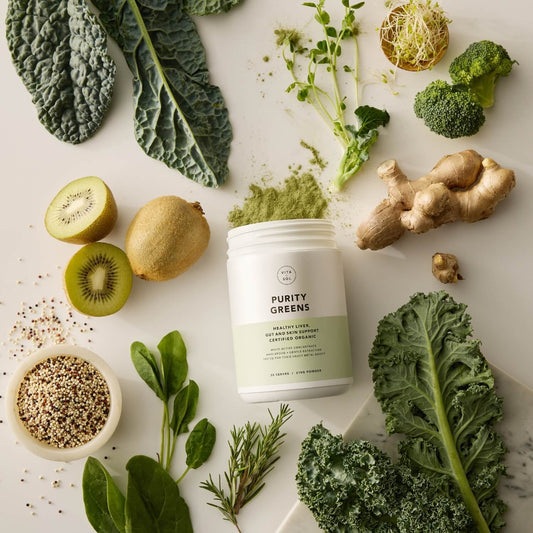
Purity Greens combines 32 wholefood plant ingredients, providing a practical way to introduce a greater variety of plants into the diet alongside everyday food.
That distinction is important.
Purity Greens is not intended to replace vegetables, fruit, wholegrains, nuts, seeds or a varied diet. Food comes first.
The formulation reflects a simple principle explored throughout this article: different plants bring different nutritional components to the diet.
Its mixture of wholefood greens and other plant ingredients provides naturally occurring fibres, polyphenols and phytonutrients from multiple plant sources rather than relying on a single isolated ingredient.
For someone already working towards a varied diet, it offers another convenient way to add diversity rather than replace it.
Skin Is More Than Skin Alone
The Gut-Liver-Skin Axis does not provide a simple explanation for every skin concern, and it should not be treated as one.
What it offers is a broader lens.
The gut absorbs and interacts with what we eat. The microbiome transforms components of that food into compounds of its own. The liver processes what arrives from the digestive system. Immune, hormonal and metabolic signals circulate throughout the body, and the skin exists within that same interconnected network.
That brings us back to Dr Steph's framework:
The gut decides what gets absorbed.
The liver decides how it's processed.
The skin shows the result.
For anyone interested in skin health, the practical lesson is straightforward: do not look at the skin in isolation.
Professional skincare can support it from the outside. A varied, nutrient-rich diet can support the body from within. Sleep, stress, movement and other lifestyle factors form part of the same wider picture.
Healthy skin is unlikely to come down to one ingredient, one product or one treatment. It sits within the health of the system as a whole.
Frequently Asked Questions
What is the Gut-Liver-Skin Axis?
The Gut-Liver-Skin Axis describes the interconnected relationship between the gut, liver and skin. These systems communicate through metabolic, immune and hormonal pathways, meaning activity in one area may influence processes elsewhere in the body.
How does gut health relate to skin health?
Research into the Gut-Skin Axis has identified associations between the gut microbiome and skin conditions including acne, rosacea, atopic dermatitis and psoriasis. Scientists are studying mechanisms such as immune signalling, intestinal barrier function and microbial metabolites. An association does not mean that gut changes directly cause or cure a skin condition.
What is the gut microbiome?
The gut microbiome is the community of bacteria, fungi, viruses and other microorganisms living within the digestive system. These microorganisms help metabolise components of food, interact with the immune system and produce compounds that influence normal gut function.
Why is plant diversity important for the gut microbiome?
Different plant foods provide different fibres, polyphenols, resistant starches and other compounds. Different groups of gut microorganisms can use these substrates in different ways. The American Gut Project identified differences in microbial communities between people reporting relatively low and high plant diversity in their diets.
What are prebiotics?
Prebiotics are substances selectively used by microorganisms in ways that can benefit the host. They occur naturally in many fibre-rich plant foods, including vegetables, fruit, legumes, wholegrains, nuts and seeds.
What are postbiotics and butyrate?
Postbiotics are compounds associated with microbial activity. Butyrate is a short-chain fatty acid produced when certain gut bacteria ferment dietary fibre. It is an important energy source for cells lining the colon and has been extensively studied in relation to intestinal barrier and immune function.
Where does the '30 plants a week' idea come from?
The idea comes from the American Gut Project, which compared people consuming 10 or fewer different plant types per week with those consuming more than 30 and identified differences in microbial communities and metabolites. It was an observational citizen-science study, so "30 plants" is best viewed as a useful dietary-diversity concept rather than a strict clinical threshold.
What role does the liver play in the Gut-Liver-Skin Axis?
Blood carrying nutrients and other compounds absorbed from the digestive tract travels to the liver through the portal circulation. The liver processes nutrients, metabolises hormones and drugs, and prepares metabolic waste products for elimination, placing it between the gut and the wider circulation.
Can improving gut health treat skin conditions?
Not necessarily. Research has identified associations between the gut microbiome and several skin conditions, but this does not mean altering the microbiome will treat or resolve them. Professional diagnosis and appropriate treatment remain important.
How can I support my gut microbiome through diet?
A practical starting point is to eat a varied diet containing plenty of different plant foods. Vegetables, fruit, wholegrains, legumes, nuts, seeds, herbs and spices all provide different fibres and plant compounds that contribute to dietary diversity.
Where does Purity Greens fit?
Purity Greens contains 32 wholefood plant ingredients and is designed as a convenient way to add greater plant variety alongside a balanced diet. It is not intended to replace vegetables, fruit, wholegrains, nuts, seeds or other whole foods.